Putting Together a Mobile Sensory Cart

Earlier this year, my friend Kim Botto published a blog post that talked about helpful sensory items for kids who need extra support. (In fact, her ministry is centered around creating safe, inclusive spaces for every child. Check out her website here.)

In the post referenced above, Kim wrote that leaders don’t need a big budget or a dedicated room to provide special needs ministry. “Start with a cart” was one takeaway I gleaned. So that got me thinking…

My Little Friend

We have a handful of children who benefit from a short break from the larger group environment. I’ve observed that these breaks are most needed after a transition time or during a circle or rug activity. On one recent occasion, one little friend took a walk with me and I pulled a preschool-friendly Bible to read the story that he would miss. He was quite engaged and we had a delightful conversation about it. Shortly after our time together, he was able to rejoin his class, ready for the final few activities.

That encounter reminded me of Kim (who I texted that afternoon to share details) and the post that I’ve referenced. I had the preschool Bible readily available and thought, “What if I had other resources readily available as well? What do we have? What do we need?” These questions prompted me to begin gathering supplies for our mobile sensory cart.

Let’s Get Started

I decided to start with items we already had. We had a cart that wasn’t being used. We had Bibles, blank copy paper, large crayons, and markers. Facial tissue, dot markers, magnetic drawing boards, play dough, and a few stuffed teddy bears were also in our inventory. Our curriculum provides a special needs component, so I downloaded and laminated a feelings chart.

I did a little research and purchased other items that I thought would be useful. Here’s a link to a list with the items on our cart.

The Finished Product

Here are a few pictures of the finished product:

Mobile sensory cart
Books
Bibles
Feelings chart
Sensory toys and bubble wrap
More sensory toys
Noise cancelling headphones

I still have a few additional resources that I’ll add, but for now, I’m pretty pleased with the way it turned out. Our cart is mobile but sits in our volunteer refreshment room for easy access.

Thank you again to my friend Kim Botto, who regularly reminds me that kids ministry should be welcoming and inclusive to all. Check out her website to learn more and take advantage of the resources she provides – many are free of charge!

Now it’s your turn…how do you create safe, inclusive spaces for kids? What sensory items have you purchased?

An Inside Look at Our VBS Sensory Room

We’ve been doing VBS at our church for a very long time, and sometimes it can be challenging to breathe new life into a beloved program. This year, I gathered our planning team for a theme brainstorming meeting before we began the planning process. We chose Group Publishing’s “Rainforest Falls” VBS program, so our meeting yielded ways to make the theme come alive.

One of the ideas that bubbled to the top was to incorporate a rainforest-themed sensory room for kids who needed a short break from the camp experience. My daughter Kennedy, who originally proposed the idea, developed it into something that blew our minds. We won’t be able to offer VBS without a sensory room ever again!

I asked her to share more about the room with all of you.

Designing the Space

During the beginning of the initial brainstorming of the room designing process, there was one thing I had in mind: create a calming place for any kids who need to rest and recharge during camp. As a teacher, I had a few general ideas in mind as to what could be included in the room that would help to achieve this mission including lights, decor, and various activities.

Setting the Boundaries

Because I wanted this space to be more of a resource instead of a distraction during the program, I put some policies into place to ensure that the room was used to the best of its ability. I anticipated some campers coming into the space and not necessarily wanting to leave, so I placed an initial boundary on how long they could spend in the room during camp hours. After observing children using the space throughout the week, I discovered that 5-10 minutes was an ideal time frame for the kids to spend there. They always had to be accompanied by one of their adult or student crew leaders for the time that they visited the room. The space was also available to families briefly before camp and after for kids who wanted more time.

Cozy Corner

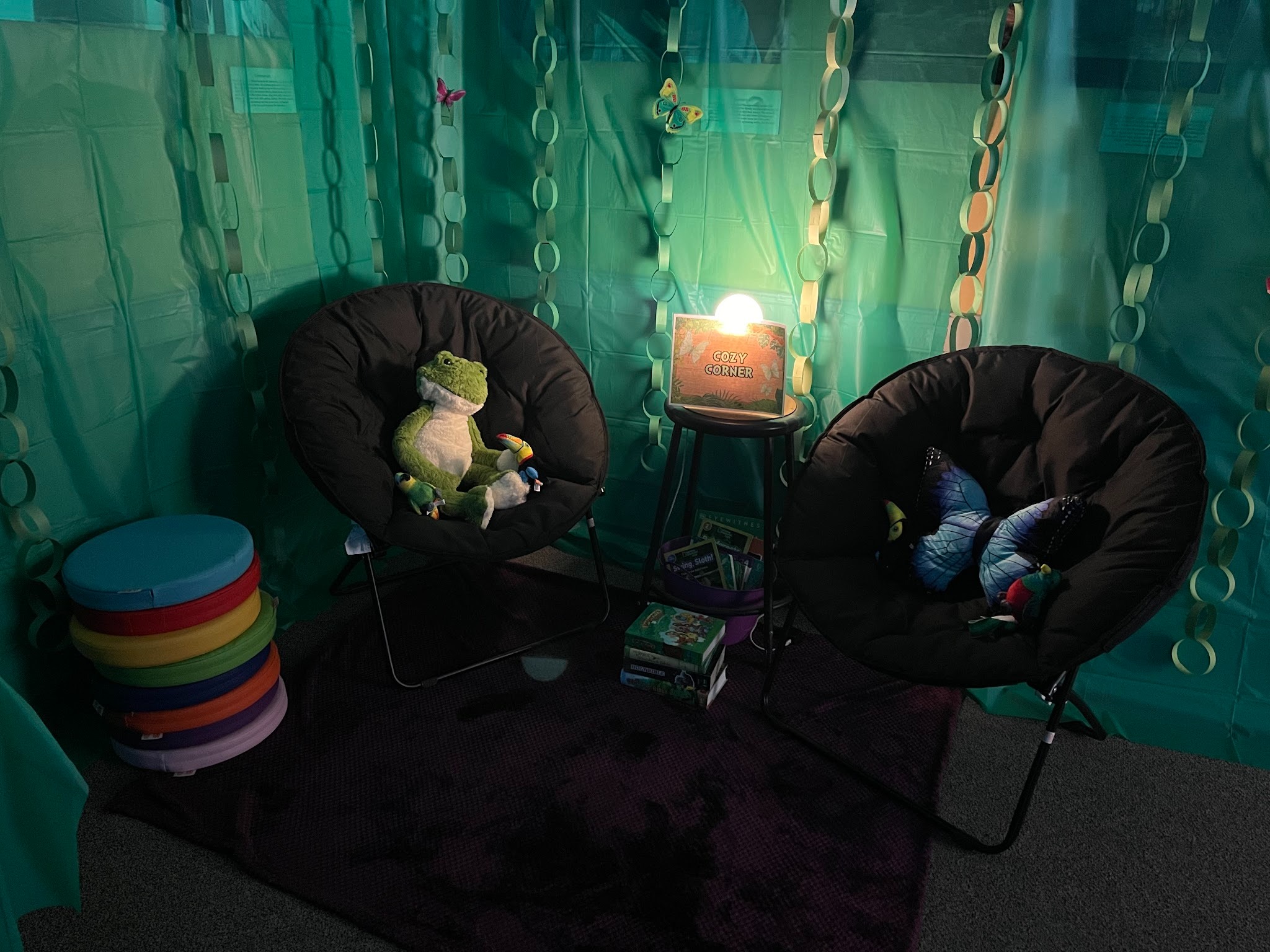
A cozy corner was a must-have for this space. In order to create this area, I laid down a soft washable rug and placed two comfy folding chairs with rainforest-themed plushies and pillows. Some stackable colorful cushions were also included for comfortable seating as well. This area also included some rainforest themed books and a set of Bibles for various ages.

Writing Station

The writing station included some rainforest themed notecards for campers to write a prayer or an encouraging note to a friend.

Coloring & Sticker Station

The coloring and sticker station was one of our most popular stations in the room for the week. This station included cardstock in various colors, rainforest-themed stickers, Washi tape, coloring pages, and rainbow scratch art paper cut into butterflies and other bugs. There was also an 8-cup caddy placed on the table in between the two stations that contained crayons, colored pencils, markers, pencils, and sharpeners.

Butterfly Wall

In an attempt to give the campers an authentic rainforest experience, I decided to create a butterfly search and find wall. This wall was designed using paper chain vines and a green plastic tablecloth. I printed out some real butterflies that could be found in the rainforest and taped them to the vines at various heights for the campers to see. I included a flip book guide for them to use along with some magnifying glasses and dry erase markers.

Other Activities

Because the space was designed for campers ages K-rising 6th grade, I wanted to include some other activities that everyone could enjoy, especially for campers who prefer more hands-on activities. Some of these activities included LEGOs, Magna-Tiles, a marble run set, and a rainforest floor puzzle.

Sensory Station

The final area in the room was the sensory station. This station included a color changing ball light, pom-pom sorting, a small rainforest/jungle playset with plastic bugs, and a few sensory bottles that contained rice, water beads, pony and letter beads, and beans. 

I hope this post inspires you to create your own sensory room for your VBS.

Have you ever thought about creating a safe and quiet place for your campers to recharge and refocus during the business of VBS programming?

error: Content is protected !!